
What changes when an arm guard goes hunting
By Corinne Vasek, club archery coach · Updated
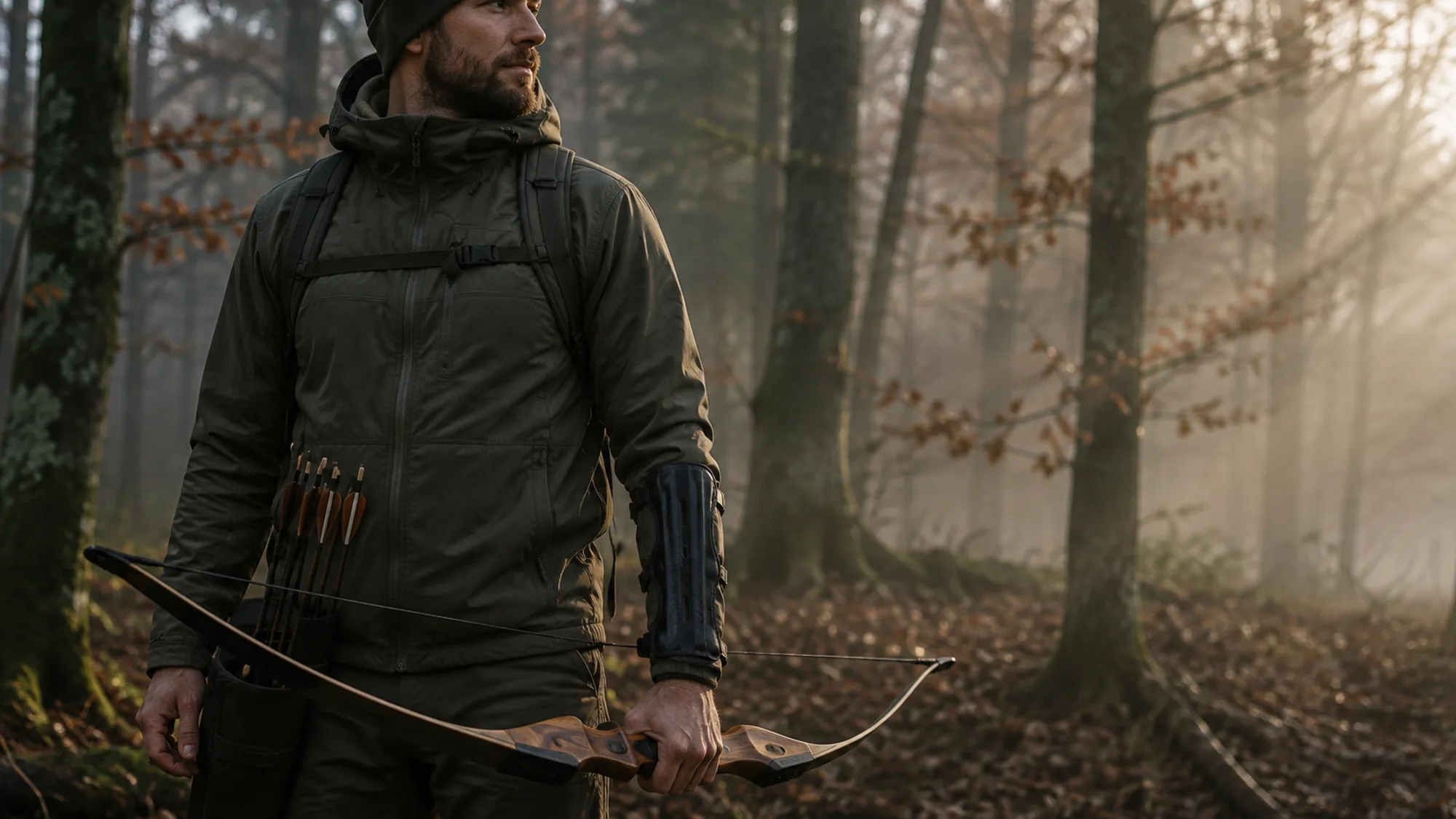
Every arm guard on a shooting line is solving one problem under one set of conditions: a warm archer, in light clothing, standing square on flat ground, taking the fortieth shot of the afternoon. Carry the same guard into the woods and almost none of that still holds.
The plate does not care. It spreads a string impact on a club field and in a treestand in exactly the same way. What changes is everything the guard has to cope with on the way to that one draw, and those things are why a guard that felt invisible all summer can start making itself known in the first week of a season.
On this page
The range forgives a bad shot — a season does not.
The cuff problem, in its heaviest form.
Noise — the requirement a target line never has.
Stands, blinds and untested angles.
The pre-season check — four things, ten minutes.
The range forgives a bad shot. A season does not.
On a club evening you might loose eighty arrows. If the string catches your forearm on the twelfth, you have a stripe on your arm and sixty-eight arrows left in which to think about why. The cost of the error is one point and an evening of mild annoyance.
Hunting inverts that arithmetic completely. There is a long approach, a much longer wait, and then a single draw. The shot that matters is the first one of the day, frequently the only one, and it gets taken cold, from a posture you did not choose, after your bow arm has been motionless for an hour.
Two consequences follow, and both of them are already documented on the range side of this site. A string that clips the forearm loses energy and gets deflected, which pushes that arrow off the line you aimed on. And a hit teaches your body to protect itself: you drop the bow arm a fraction early, you pull the elbow in, you release before the sight has settled. None of those are decisions you are aware of making.
On a target line those two things cost points across a session that has plenty of shots left in it. On one opportunity, they cost the opportunity. That is the whole difference in a sentence, and it is why hunters who never wore a guard for indoor practice put one on in August.
The cuff problem, in its heaviest form
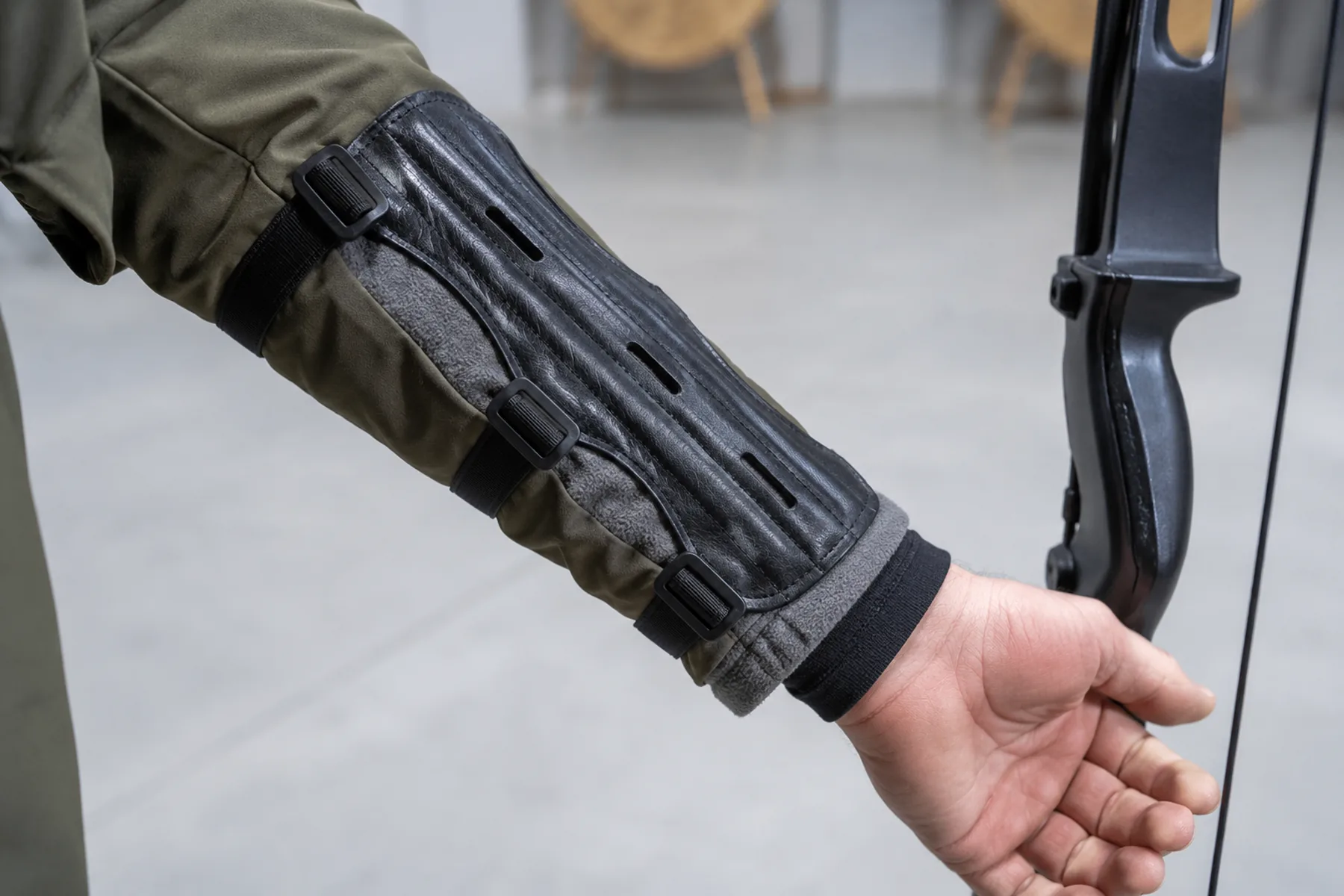
Hunting clothing is the heaviest an archer ever wears, and it is heaviest at exactly the wrong place.
A base layer, an insulating mid layer and an outer shell is three cuffs gathered around one wrist. That is a considerable amount of fabric sitting directly in the path the string travels on release. The string finds fabric long before it finds skin, and it drags that fabric across the forearm on the way past, which is how archers with fifteen clean seasons behind them take a hit on the first cold morning and blame their form.
A rigid plate strapped over the top compresses all three flat. That is the specific job a plate does and an elastic sleeve does not, because a sleeve goes underneath the clothing and leaves the cuffs free to bunch above it; the two formats are set against each other properly in arm guard against arm sleeve.
Compressing them flat is the operative phrase. A fold trapped under the plate is a ridge, and a ridge is a fresh obstacle you have just built half an inch further out into the string path. Tighten until the fabric underneath is genuinely flat rather than gathered, and if your outer shell is thick enough that the straps run out of adjustment, push the sleeve up and wear the guard against the mid layer instead. The strap order that makes this quick — middle first and snug, wrist second, elbow last and loosest — is in how to wear an archery arm guard.
Noise, which a target line never has to think about
This is the requirement with no equivalent in target archery, and it is the first thing hunters raise about any piece of kit that straps to the body. Nobody on a shooting line has ever cared what their arm guard sounds like. In cover it is a real constraint, and it has three sources.
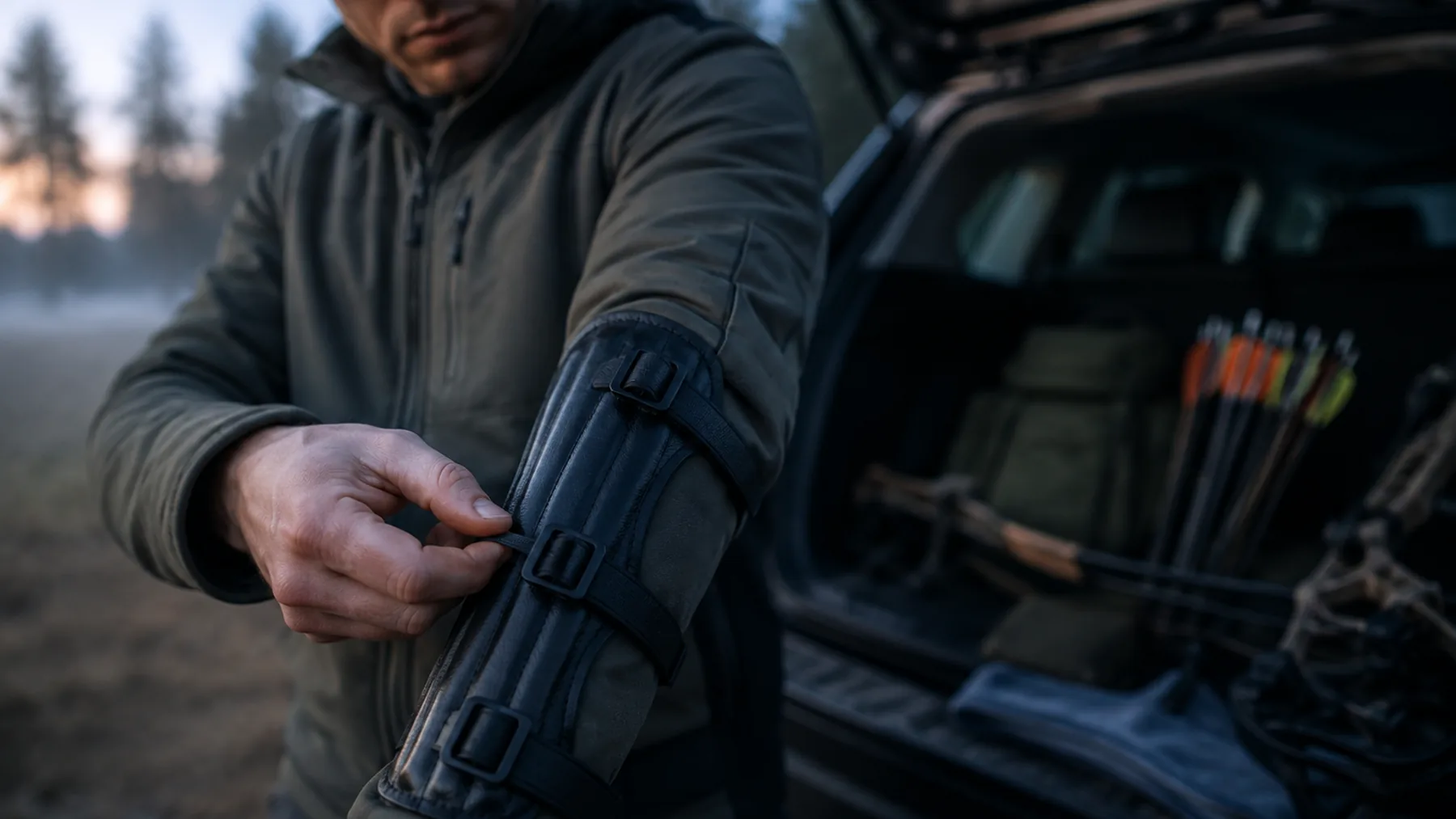
Strap tails. Elastic ends left long will slap the plate or brush the riser every time the arm moves. Trim them, or tuck them back through the buckle so nothing is loose. Do it at a kitchen table, not in the dark.
Adjustment. Anything altered once you are in position costs movement and sound, and movement is the expensive one. Set the guard before you leave the vehicle and leave it alone. This is where a closure matters more than the facing does: three elastic straps on sliding buckles are set once and forgotten, whereas any closure that reopens with a tearing sound is one you want fastened long before you are anywhere that matters.
Contact. A plate that has rotated around the forearm presents its edge rather than its face, and an edge catches on clothing and on the bow. The check is the thumb test: push the edge of the plate sideways. If it turns around your arm, the middle strap is too loose. A guard that rotates is both noisier and less protective than one that sits still, which is convenient, because fixing one fixes the other.
Stands, blinds and angles your form has not been tested at
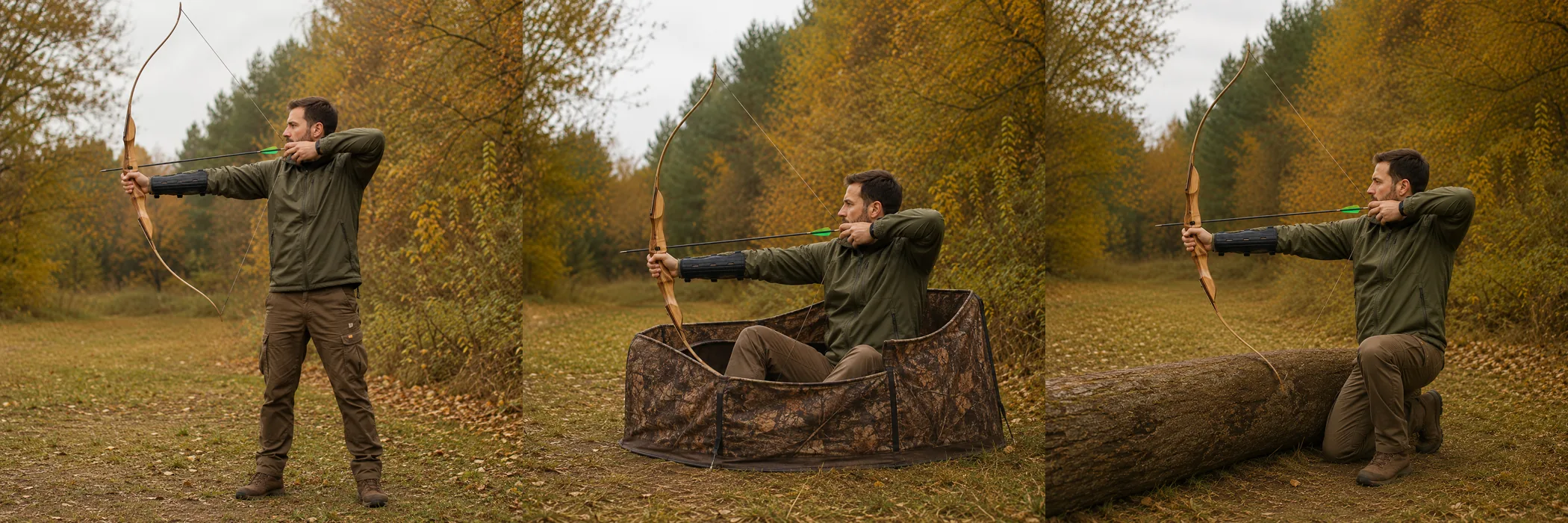
Form that clears the string standing square on level ground has been proved in exactly one posture. Hunting asks for several others, and none of them have been checked.
Shooting downward from an elevated stand bends you at the waist, which changes where the bow arm sits relative to the string without your feeling that anything has changed. Seated in a ground blind, the bow arm often ends up lower and closer to the body than it ever does standing, and the draw shortens slightly with it. Kneeling behind cover does something different again, and shooting around the trunk you are leaning on introduces a lean that rotates the whole upper body.
None of this alters the cause. A locked bow elbow that rotates the soft inner forearm into the string path is the cause on flat ground and in a stand alike, and the full breakdown of that, along with the two other causes, is in what causes string slap. What changes is simply that a posture you have never practised is a posture in which you have never verified your clearance.
The remedy costs nothing and takes an afternoon: draw at each of those angles at home, in the clothing you will actually be wearing, with the guard on. You will find out which posture brings your forearm closest to the string while there is still time to do something about it. Most people are surprised by the seated one.
Brush, cold, and the walk in
Two smaller points that both belong to the approach rather than the shot.
Brush. Pushing through cover in the dark is hard on anything worn on the arm. Fabric sleeves snag, stretch and roll down; a strapped plate takes the scrape on its face and stays where it was set. If you walk in through anything thicker than a mown path, that difference shows up within a season.
Cold. An hour of sitting still leaves the bow arm stiff and the hands slow, and the first draw of the morning is the one taken in that state. It is also the draw taken through the most clothing you will wear all day. The guard does not warm you up, but it does mean the least practised shot of your season is not also the one where you find out what three cuffs do to a string.
The pre-season check: four things, ten minutes
Kit that has spent the summer in a quiver pocket or a truck door deserves ten minutes in the weeks before a season, rather than a glance the night before. Four checks cover it.
Elastic recovery. Stretch each strap to about half again its resting length and let it go. It should snap back to where it started. Elastic that returns slowly, or returns short, has lost its tension and will let the plate walk down your forearm over an hour of sitting.
Buckle grip. Set a strap, then pull firmly against the buckle. If the strap creeps through, the plate will drift while you are drawing, which is the moment you least want it to.
Rotation. Put the guard on over your hunting layers, not over a t-shirt in a warm garage, and do the thumb test. A guard set to a bare forearm in July is a guard set for the wrong circumference in October.
The face. Look along the surface for crazing at the flex points, and check that the perimeter stitching and bound edge are intact at the corners, which is where layers separate first. A PU face lives longest away from direct sun and heat, which means a quiver pocket rather than a dashboard; the care detail is on the leather arm guard page.
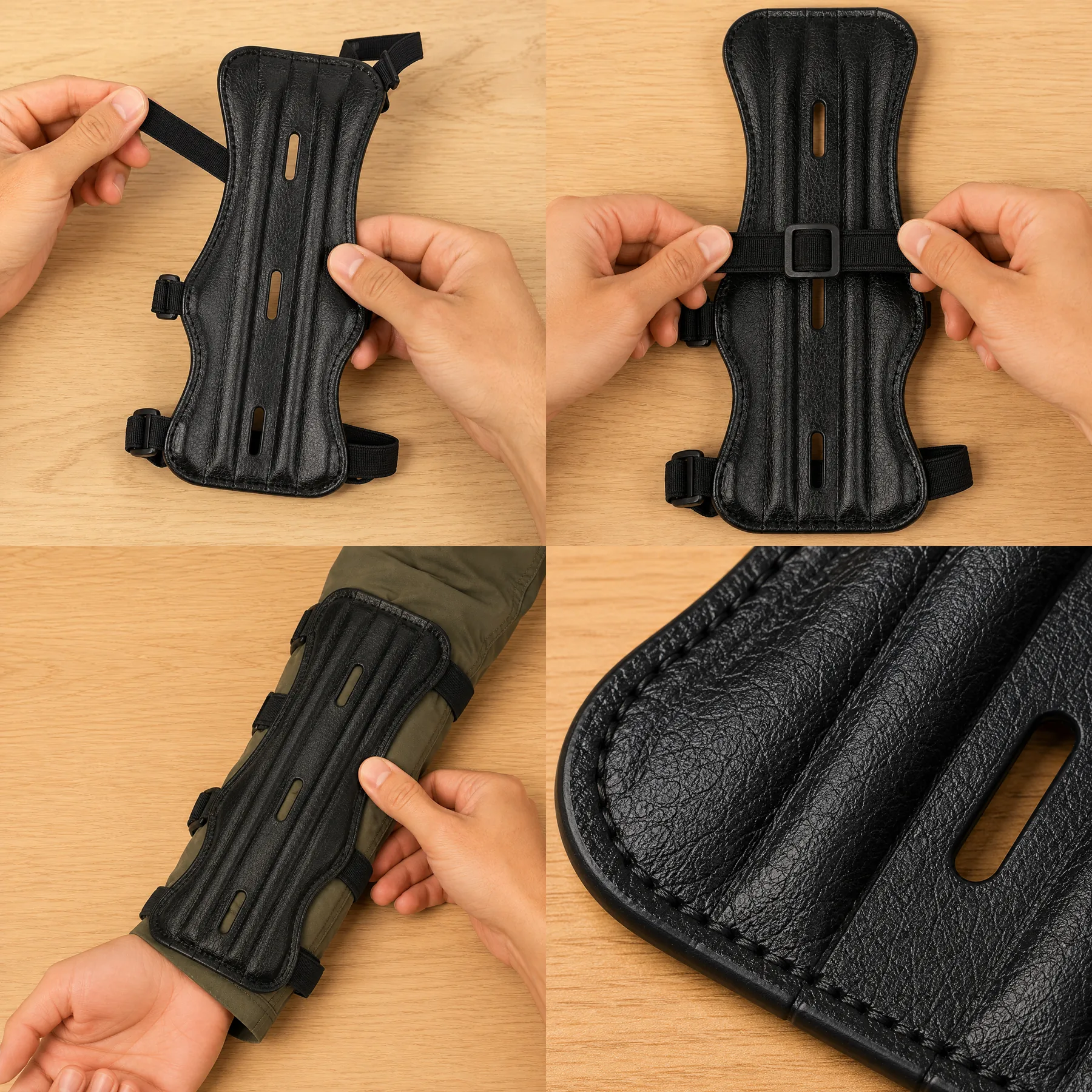
What should be on your arm on opening morning
A guard on the bow arm, which is the arm holding the bow: the left forearm if you shoot right-handed, the right if you shoot left-handed. If that sounds obvious, it is still the most common mistake on any beginners course, and the naming convention is genuinely to blame for it. The reasoning is set out on the bow arm guard page.
Fitted over the layers you will hunt in, set at the vehicle and not touched afterwards. Strap tails trimmed or tucked. Plate on the inner forearm, wide end toward the elbow, covering the run from just above the wrist bone upward, because the wrist end is where people actually get caught.
One point about sizing that the range version of this advice misses. The size guide has you measure a bare forearm, which is the right method for a summer club evening. For hunting, measure over the layers instead. A mid layer and a shell add real circumference, and a guard that sat comfortably in the middle of its adjustment range in July can be at the end of it in November.
Then leave it there. The 2023 epidemiological review of archery injuries in Orthopedic Reviews lists forearm braces among the safety equipment it recommends archers use, with no suggestion that experience makes them optional. Most archers who have been shooting for twenty years still put one on, and they do it for precisely the conditions described on this page: a cold morning, a borrowed jacket, an angle they have not drawn from before, and one shot that has to count.
Set it up before the season, not on opening morning
Three independently adjustable straps on sliding buckles, vented PU leather, one size. $19.95 with free shipping and 30 days to send it back.
See the arm guard →Related: how to wear an arm guard · what causes string slap · chest guards explained