
How to wear an archery arm guard
By Corinne Vasek, club archery coach · Updated
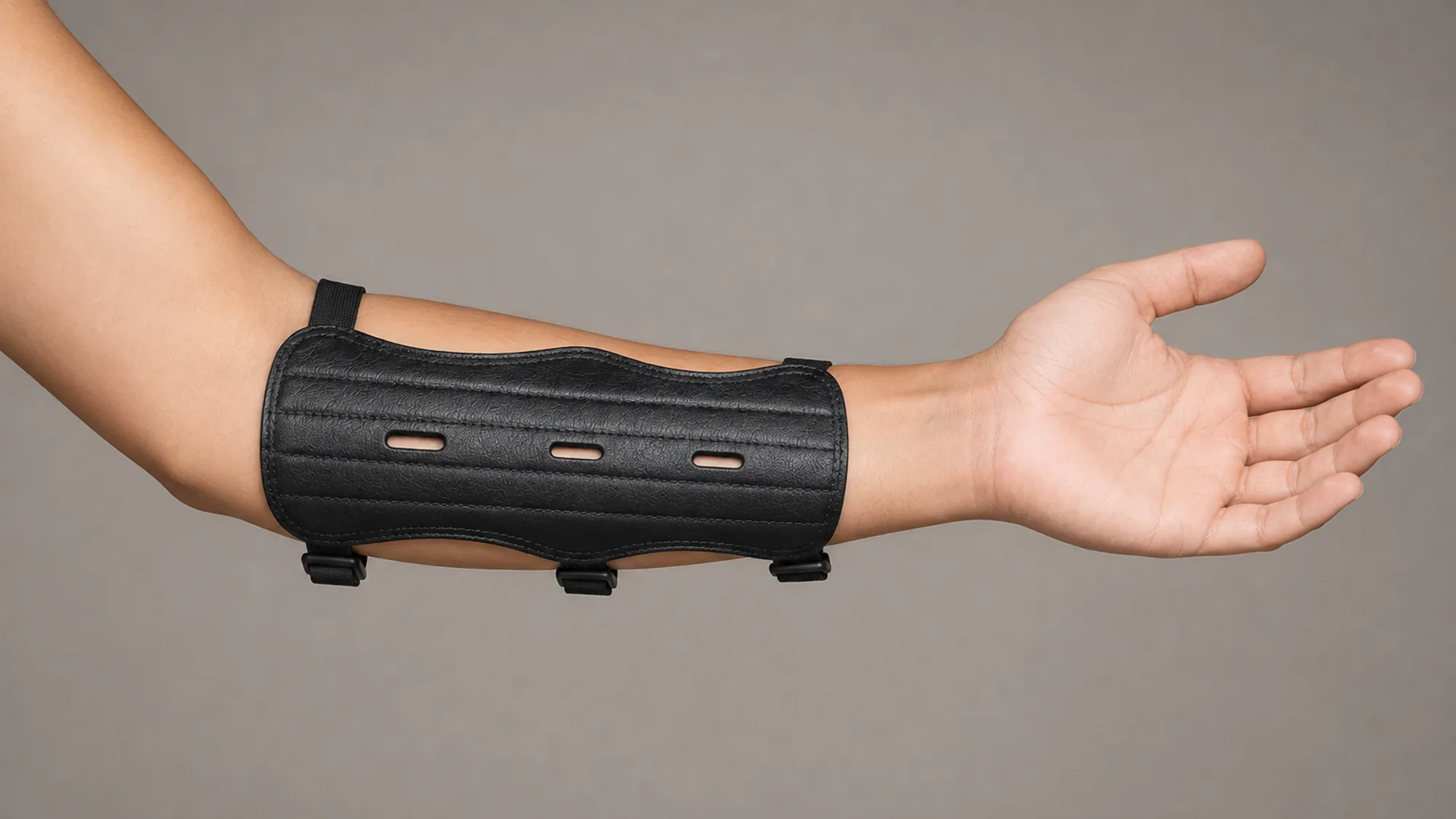
There is a moment on every beginners course where somebody puts their arm guard on the wrong arm, and nobody says anything for twenty minutes because it looks perfectly reasonable. Then the string catches their other forearm and everyone learns something.
Wearing an arm guard properly takes about thirty seconds once you know the order. Getting it wrong is not dangerous, but it wastes the guard entirely, and it is responsible for most of the reviews you will read complaining that a guard slides down or pinches. Here is the whole thing.
On this page
Which arm it goes on — the bow arm, and why the naming confuses people.
Where on the forearm — the inner face, following the string line.
The strap order — middle, wrist, elbow. This is the part that matters.
How tight is right — two tests you can do without taking it off.
Wearing it over clothing — the cold-morning problem.
Which arm it goes on
The guard goes on your bow arm, which is the arm holding the bow, not the one drawing the string. For a right-handed archer that is the left arm. For a left-handed archer it is the right.
The confusion is entirely the fault of the naming convention. Archery handedness is named after the drawing hand, so a right-handed archer draws with the right and holds the bow with the left. If you are right-handed and you have instinctively strapped the guard to your right forearm because that is your dominant side, you have protected the one arm that was never at risk. The drawing arm sits behind the string at every point in the shot cycle. It cannot be hit.
The guard itself is symmetrical, so there is no left-handed and right-handed version to buy. The same one turns around.
Where it sits on the forearm
On the inner face of the forearm, covering the run from just above the wrist bone up toward the elbow crease. Hold your bow arm out as if at full draw and look at the underside of your forearm. That soft inner surface, the pale side, is where the string travels. That is the surface the plate needs to cover.
Guards are shaped rather than rectangular for this reason. The wide end goes toward the elbow, where your forearm is thickest, and the narrower end toward the wrist. If it feels like the guard is fighting the shape of your arm, you have probably got it upside down.
A surprising number of new archers end up wearing it on the outer forearm, on the hairy side, because that is where a watch or a fitness band sits and the hand goes there by habit. It looks fine. It protects nothing.
The strap order, which is the actual skill
If your guard has three straps, do not fasten them top to bottom. Do this instead:
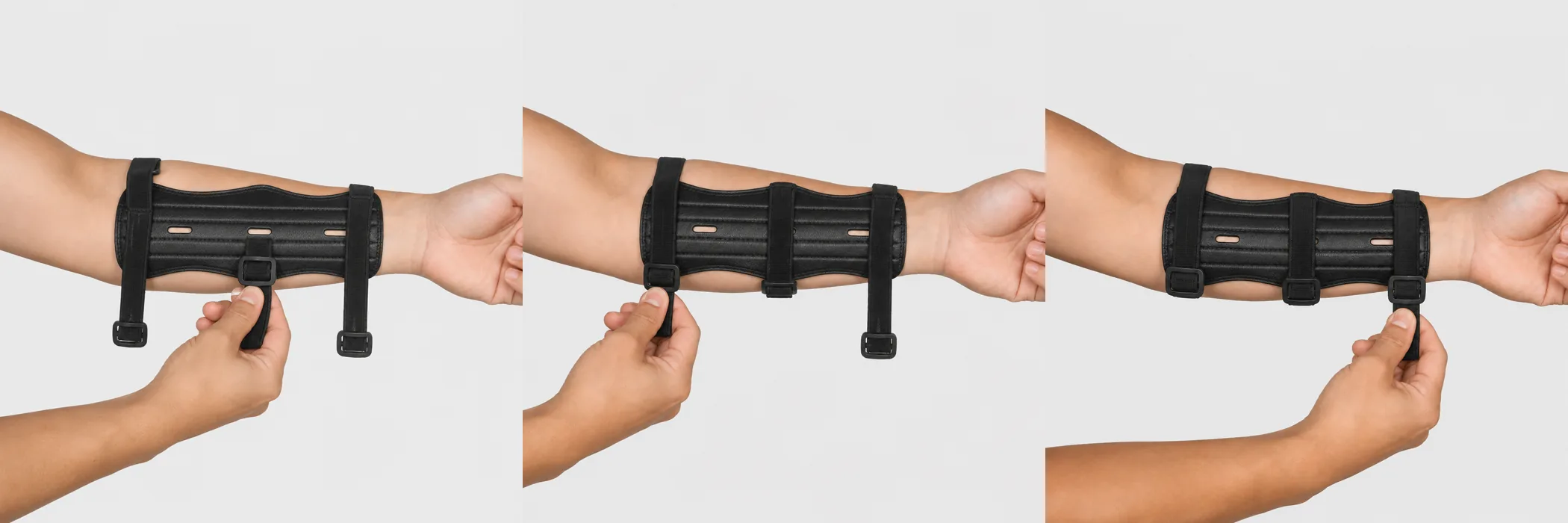
Middle strap first, and snug. This anchors the plate in the position you want it and stops everything else from dragging it out of place while you work.
Wrist strap second. Firm but not tight. This end is over the narrowest part of your arm and it is the one that will cut in if you overdo it.
Elbow strap last, and loosest. Your forearm is thickest here and it swells slightly as you warm up. Leaving this strap with the most give is what stops the guard creeping down toward your wrist over an hour.
That is the whole technique. It sounds trivial written down, and it is the single difference between people who describe a three-strap guard as fiddly and people who never think about it again. In the review corpus for the guard we sell, three buyers out of forty-one described the first fitting as awkward, and not one of them mentions it as an ongoing problem. They had worked out the order by the second session.
Two-strap guards have the same logic with less nuance: wrist first, elbow second and looser. The reason a third strap is worth having is that with only two, the plate can pivot around the midpoint between them when a string hits it, and you end up straightening it every few ends.
How tight it should be
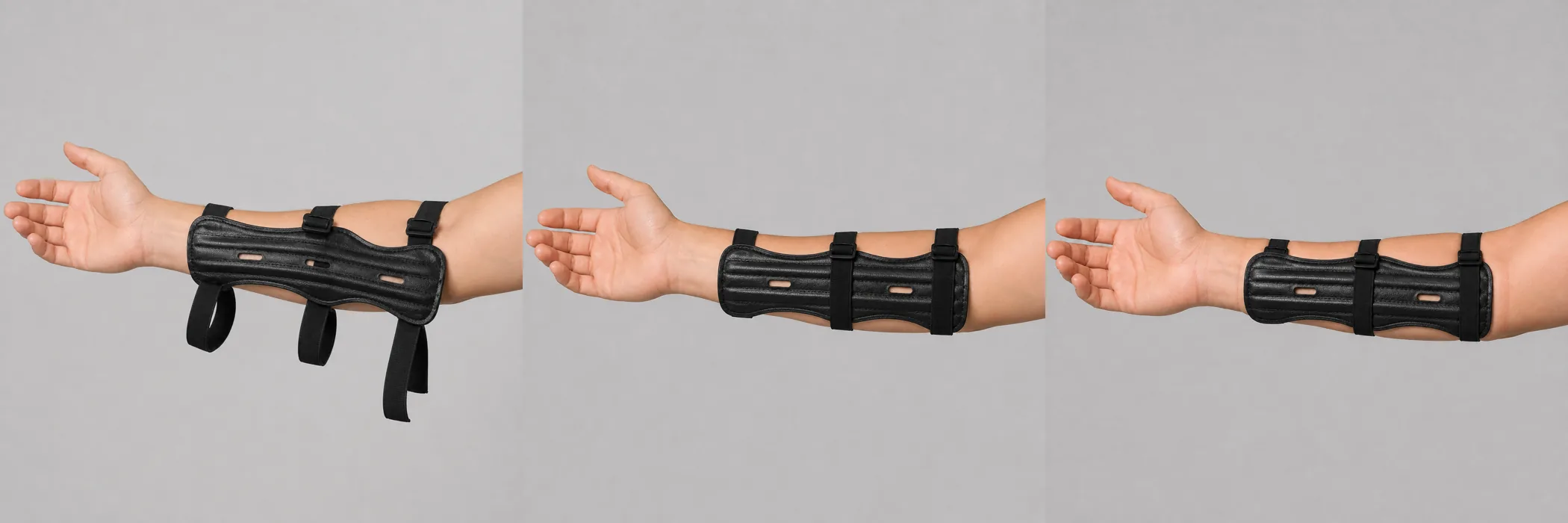
Snug enough that it cannot rotate, loose enough that you forget you are wearing it. Two tests, both of which you can do without taking anything off.
The thumb test. Push the edge of the plate sideways with your thumb. If it rotates around your arm, the middle strap is too loose. A guard that turns while you shoot ends up presenting its edge to the string instead of its face, which is worse than no guard at all because an edge concentrates the impact.
The twenty-minute test. Shoot for twenty minutes and check your fingertips. Any tingling, coolness or colour change means the wrist strap is too tight and you are restricting blood flow. Loosen that one strap, not all three.
People consistently overtighten on their first session because they are nervous about the guard moving. It does not need to be clamped. It needs to be stable.
Wearing it over clothing
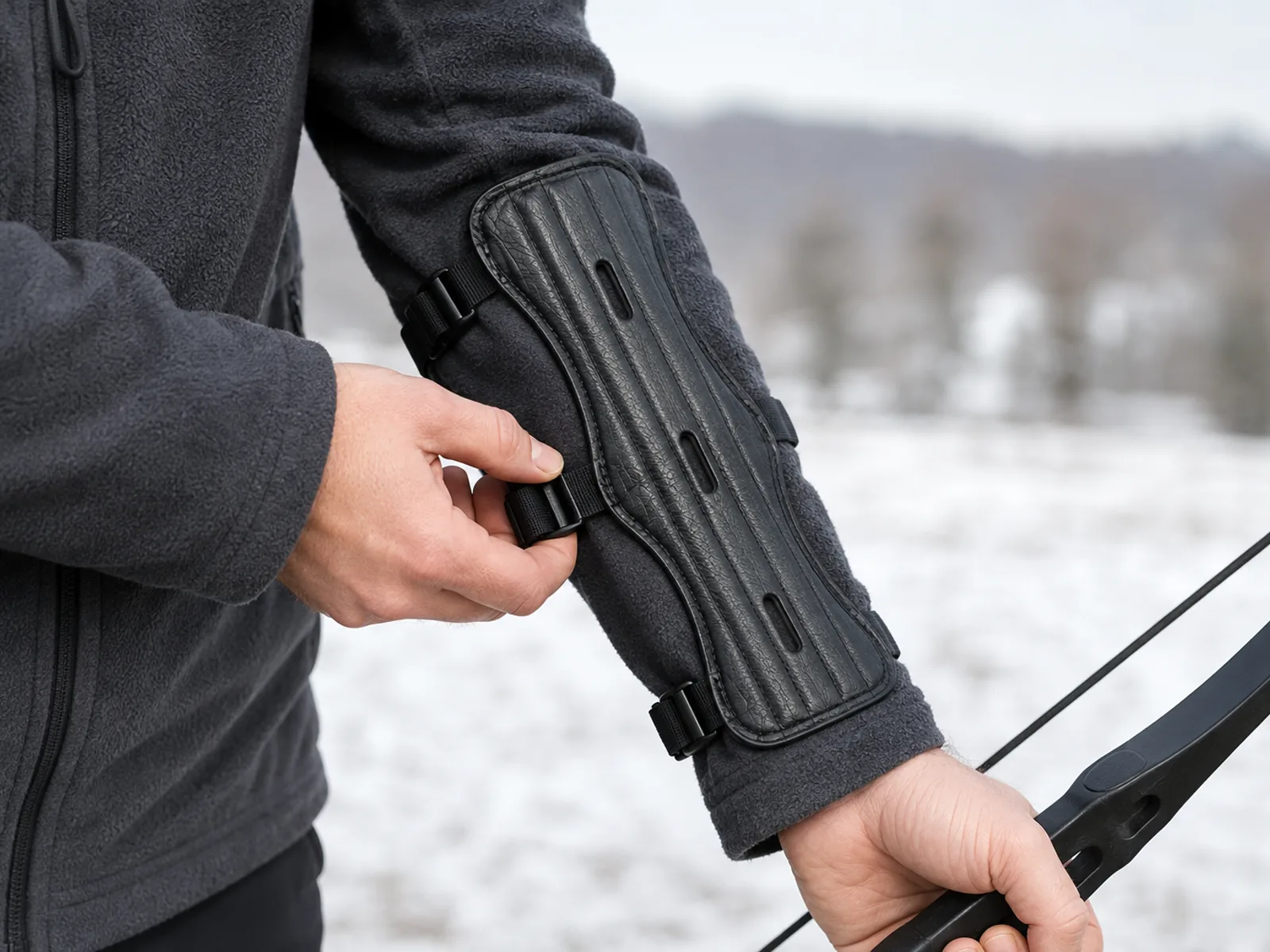
This is where experienced archers get caught out, and it is worth more attention than it usually gets. A fleece or jacket sleeve adds bulk in exactly the place the string passes. Archers who have shot for years without ever being hit will suddenly take one on the first cold morning of the season, and they blame their form when the answer is their coat.
Wear the guard over the sleeve, not under it, and tighten the straps until the fabric underneath is compressed flat rather than gathered into folds. A fold under the plate is a ridge, and a ridge is a new obstacle sticking out into the string path. You have not solved the problem, you have moved it outward by half an inch.
If your jacket is thick enough that the straps run out of adjustment, push the sleeve up your arm and wear the guard against your base layer instead. Slightly colder, considerably safer.
Five mistakes I see every term
Wrong arm. Covered above, and it is the most common by a distance.
Too high. The guard ends up near the elbow with the wrist exposed. The string travels the whole length of the inner forearm, and the wrist end is where most beginners actually get caught.
All three straps equally tight. A forearm tapers. Equal tension means too tight at the wrist and too loose at the elbow, and the guard walks downward over a session.
Taking it off when it gets warm. Understandable and completely counterproductive. If your guard gets sweaty and uncomfortable, the answer is a vented one, not a bare forearm.
Treating it as a beginner's item. It is safety equipment. The 2023 epidemiological review of archery injuries in Orthopedic Reviews lists forearm braces among the equipment it recommends archers use, without any suggestion that experience makes them optional.
One last thing
An arm guard does not fix your form. If the string is reaching your arm, something in your setup is putting it there, usually a locked bow elbow that rotates the soft inner forearm into the string path. Work on rotating the elbow crease outward, toward vertical, and the hits will stop regardless of what you are wearing. The full breakdown of causes is in what causes string slap.
Wear the guard anyway. It is what lets you work on the cause calmly rather than flinching your way through the next month.
The guard this guide was written around
Three independently adjustable straps, vented PU leather, one size. $19.95 with free shipping and 30 days to send it back.
See the arm guard →Related: arm guard size guide · bow arm guard · guard against sleeve