
What is an archery arm guard called? Bracer, wrist guard and the words archers use
By Corinne Vasek, club archery coach · Updated
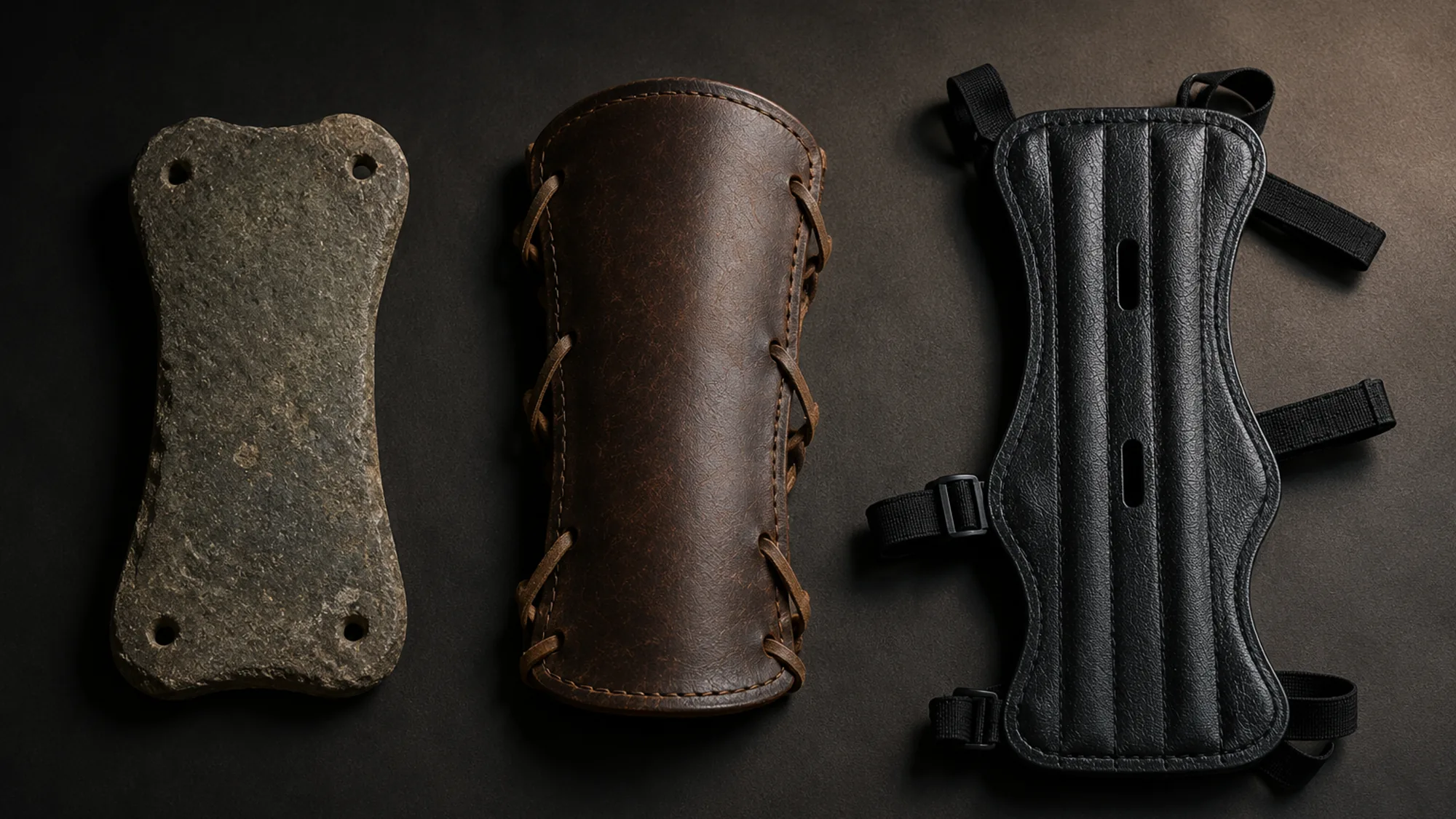
Archery keeps an unusual amount of old vocabulary alive. The equipment list at any club contains words that were current six hundred years ago, sitting next to words invented by online listings last year, and nobody warns a beginner which is which. The result is a very common first-week experience: you know the object you need, you have seen it on other people's arms, and you have no idea what to type to find it.
This guide is the vocabulary lesson. One object with at least five names, the history of the proper one, and the answers to two side questions people ask in the same breath: what you call a woman who shoots, and what you call someone who simply loves the sport. If you want to know how to put the thing on rather than what to call it, that lesson is in how to wear an archery arm guard.
On this page
Where the word bracer comes from — Chaucer got there first.
Wrist guard — a right name in the wrong place.
What shops and listings call it today.
Vambraces and the Viking bracer — a short detour.
What a girl who does archery is called.
The proper name: a bracer
Ask a traditional archer, a museum curator or a crossword setter, and the answer is the same: the guard worn on the inside of the bow arm is a bracer. It is the oldest English name for the object, it is still the word used in historical and traditional archery circles, and it appears on the equipment lists of longbow societies today exactly as it appeared in medieval household inventories.
A bracer has always meant the same thing it means now: a plate of stiff material, once horn, bone or thick leather and now usually plastic or faced synthetic, strapped over the inner forearm of the arm that holds the bow. Its job has not changed in six centuries either. When the string comes forward it can clip the soft inside of the forearm, and the bracer takes that strike so the arm does not. The mechanics of that impact, and the form faults that cause it, are covered in what causes string slap.
So if the question is a pub-quiz one, the answer is bracer. If the question is what to type into a search bar, the answer is different, and that difference is most of this article.
Where the word bracer comes from
Bracer arrived in English from Old French. The French braciere was a piece of arm armour, built on bras, the ordinary French word for arm, which in turn descends from the Latin bracchium and, further back, the Greek brakhíōn. The same root gives English the word brace and, by a much stranger route, the brassiere. A bracer is literally an arm-thing; the language never recorded anything more poetic than that.
The word was already ordinary equipment vocabulary by the late 1300s. Chaucer, describing the Yeoman in the General Prologue to The Canterbury Tales, equips him head to foot as a working archer, and on his arm places "a gay bracer" — a bright one, gay meaning showy rather than anything else. It is a throwaway detail, which is exactly what makes it good evidence: by 1400 a bracer was so standard that a poet could name it in passing and expect every reader to picture it.
The object is far older than the English word. Stone plates shaped for the inner forearm turn up in European graves from the Bronze Age, drilled at the corners for straps, and archaeologists catalogue them as bracers or archer's wrist-guards. The man known as the Amesbury Archer, excavated near Stonehenge by Wessex Archaeology in 2002, was buried with stone wrist-guards among his archery kit. People have been strapping something stiff to the bow arm for roughly as long as people have drawn bows.
Wrist guard: a right name in the wrong place
Plenty of archers, and plenty of listings, call the same object a wrist guard or an archery wrist guard. There is no separate product hiding behind that name. Someone searching for an archery wrist guard and someone searching for a bracer are looking for the same plate, and both searches end at the same object.
The name is slightly off anatomically, which is the one thing to understand about it. The string does not usually strike the wrist. It strikes the fleshy inside of the forearm, roughly a third of the way down from the elbow, which is why a properly fitted guard sits on the forearm with its lower edge near the wrist rather than on the wrist itself. The guard covers the line the string travels; the wrist is simply where that line runs out. Our size guide shows exactly where the plate should sit and how to measure for it.
It is also a name that collides with other sports. A skater's wrist guard is a rigid splint designed to stop the wrist bending in a fall, and it protects the joint itself. An archer's so-called wrist guard protects skin from a string strike and does nothing for the joint. Same two words, different object, different job — one more reason the archery world quietly prefers arm guard or bracer.
What shops and listings call it today
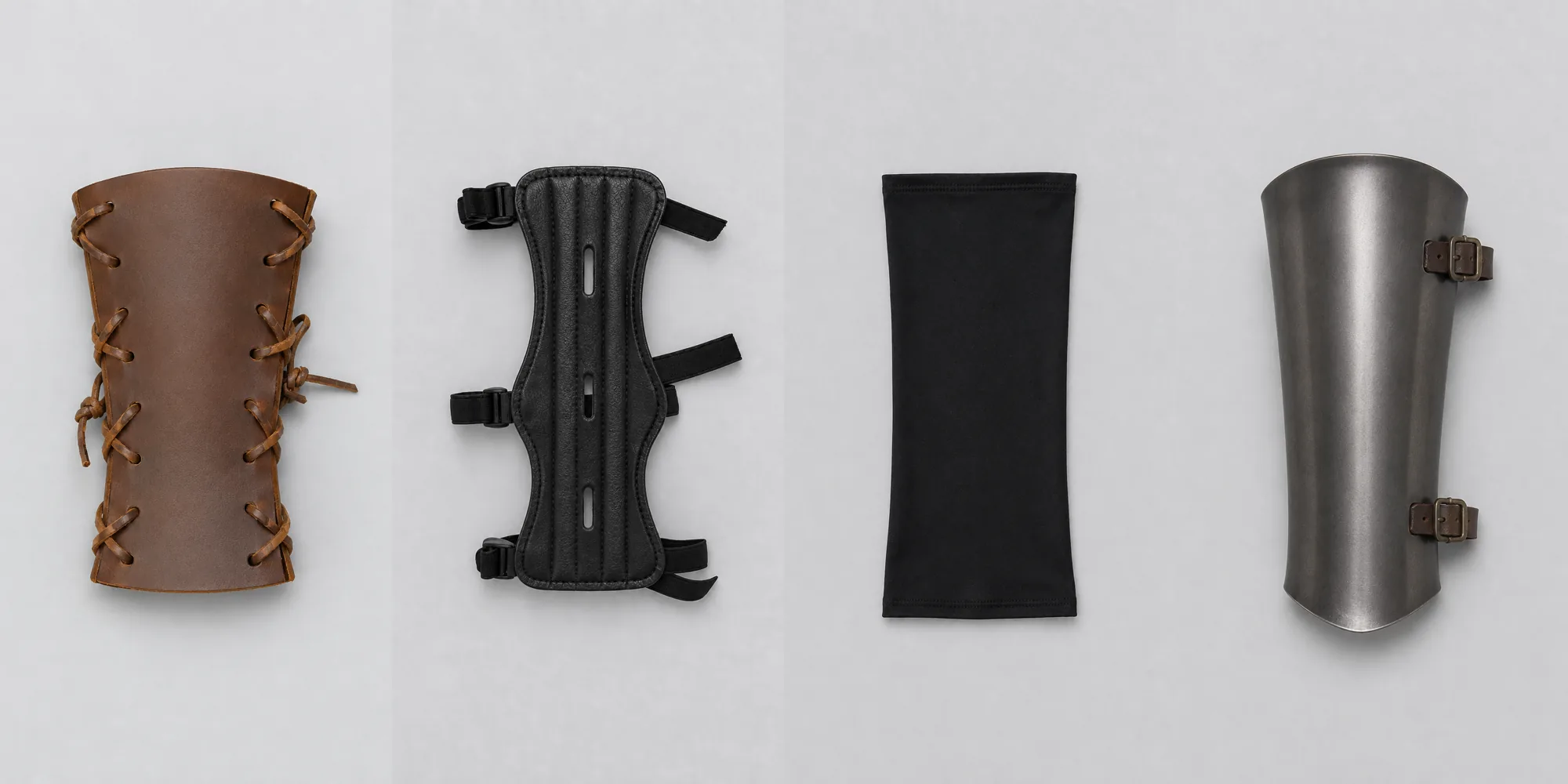
Modern retail has multiplied the names, and each one carries a small clue about what you will find under it. Here is the map.
| Name | Who says it | What it usually points to |
|---|---|---|
| Bracer | Traditional and historical archery, longbow societies | The same object, often in full-grain leather |
| Arm guard / armguard | Clubs, coaches, most shops | The standard modern term, one word or two |
| Bow arm guard | Careful listings | Specifies the arm it goes on: the one holding the bow |
| Wrist guard | Beginners, casual listings | The same plate, named after the wrong joint |
| Arm sleeve | Target archery | A different format: elastic fabric, no rigid plate |
| Vambrace | Reenactment and armour circles | Full forearm armour, not shooting equipment |
Two rows deserve a sentence more. Bow arm guard is the most precise of the everyday names, because it answers the question every beginner asks next: it goes on the arm that holds the bow, not the arm that draws. The reasoning, and what happens when people get it backwards, is on our bow arm guard page. And arm sleeve is the one entry in the table that is genuinely a different product, an elastic tube rather than a strapped plate; the two formats are compared properly in arm guard vs arm sleeve.
A short detour: vambraces, and the Viking bracer
Search for bracers and the results fill up with Norse costume kit, so the detour is unavoidable. The screen Viking wears laced leather bracers on both forearms; the archaeological record is far quieter, partly because leather rarely survives a thousand years in the ground, and the lavish forearm kit of television drama is costume design rather than excavation. The reenactment world also borrows vambrace, from the Old French avant-bras, forearm — but a vambrace is armour, plate protection against blades, built for a fight rather than for a bowstring. If you shoot, the word you want is still bracer. If you are dressing as a Viking, buy whatever looks the part; the string does not care about history.
What is a girl who does archery called?
An archer. That is the whole answer in competitive use: World Archery results, Olympic listings and club sheets all say women's recurve, women's compound, and the individuals on those sheets are archers. The sport settled this one a long time ago, and nobody on a shooting line has ever been corrected for calling a woman an archer.
The word people are usually fishing for when they ask, though, is archeress. It is a real English word — dictionaries have carried it since the Middle Ages, and Victorian translators were fond of it for Artemis and Diana, the archer goddesses of the Greek and Roman myths. What it is not is current. It reads today the way poetess and aviatrix read: historical flavour, occasionally used with a wink, never used on a results sheet. Use it for a goddess or a character name; use archer for the person beside you at the range.
The equipment, for the record, is exactly as unisex as the title. A bracer has no gendered version, and the fit question is about forearm circumference, never about who the forearm belongs to.
What is a lover of archery called? A toxophilite
English keeps one genuinely spectacular word in this field: toxophilite, a person devoted to archery. It is built from Greek — toxon, bow, and philein, to love — and the practice itself is toxophily. If the shape of the first half looks familiar, it should: toxin comes from the same root, via toxikon pharmakon, the poison that ancient archers put on arrows. The bow got into the language of poison before the poison got a word of its own.
The word has a birth certificate, which is rare. In 1545 Roger Ascham, scholar and later tutor to the future Elizabeth I, published Toxophilus, a defence of archery written in English and dedicated to Henry VIII. He invented the title from the Greek to mean lover of the bow, and named his book's central speaker after it. When London gentlemen founded an archery society in 1781, they reached for Ascham's coinage and called themselves the Toxophilite Society — the Royal Toxophilite Society from 1787 — and the club still exists. The dictionary word toxophilite is, in effect, the society's name generalised.
Nobody will ever ask you for the word at a range, which is precisely its charm. It survives in crosswords, in quiz machines and on the letterhead of one very old club, and dropping it correctly is the linguistic equivalent of a perfectly fletched arrow.
Which word to use when you are searching
Use arm guard when you want the modern object, because that is the name under which the current market lists it. Add archery in front so the results do not drift toward skating rails and weightlifting sleeves. Reach for bracer when you specifically want traditional kit or full-grain leather, because that word filters the results toward the historical end of the market — and read what the word leather is doing on those listings before you pay leather prices, because the word does more work on listings than the hide does.
And whichever name you type, you are looking for the same short checklist underneath it: a plate stiff enough to spread a string strike, straps that adjust to a tapering forearm, and a stated material. Ours is the three-strap vented version, listed — in the plainest modern dialect — as an archery arm guard. Chaucer's Yeoman would have called it a bracer. The string treats both exactly the same.
Whatever you call it, this is the one we make
Bracer, arm guard, wrist guard — one object. Three adjustable straps, vented PU leather, $19.95 with free shipping.
See the arm guard →Related: bow arm guard · arm guard vs arm sleeve · what causes string slap